The larger the company, the more frequent the AI use
The most robust figure from this entire dossier is also the simplest: AI usage increases directly with company size. That pattern is reflected in Dutch, European and American statistics, with comparable proportions.
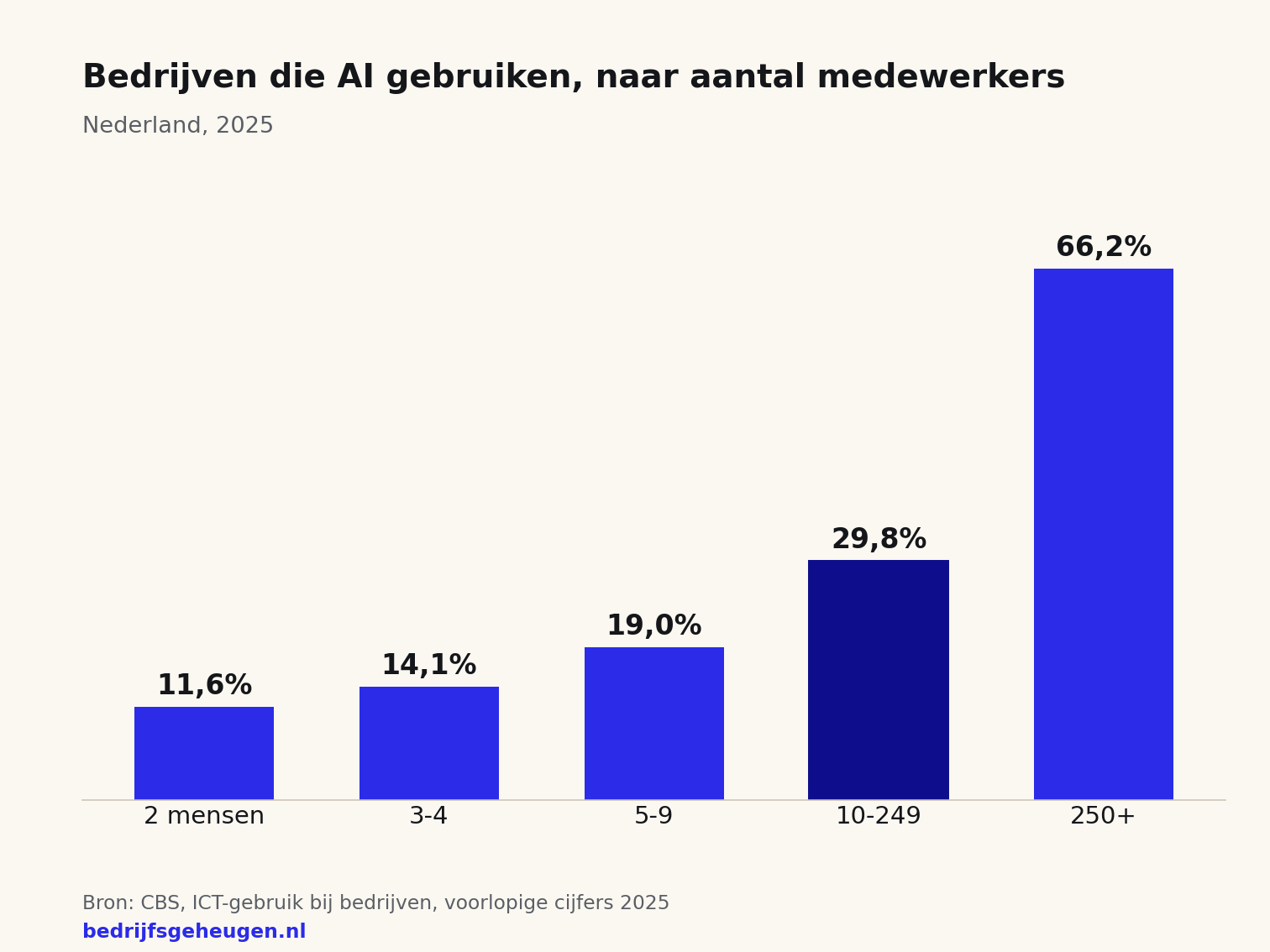
In 2025, 13.8 percent of microbusinesses (2 to 9 employees) used at least one AI technology. Among SMEs with 10 to 249 employees, that figure was 29.8 percent, and among large businesses, 66.2 percent. The figures also vary within microbusinesses: 11.6 percent for businesses with two employees, 14.1 percent for those with three to four, and 19.0 percent for those with five to nine.
Type over this order number. Once is doable. Forty times a day, every day, is a job.
Where small and medium-sized businesses are on the adoption curve
If you place those figures on Rogers’ classic adoption curve, a picture emerges that you won’t find in any report.
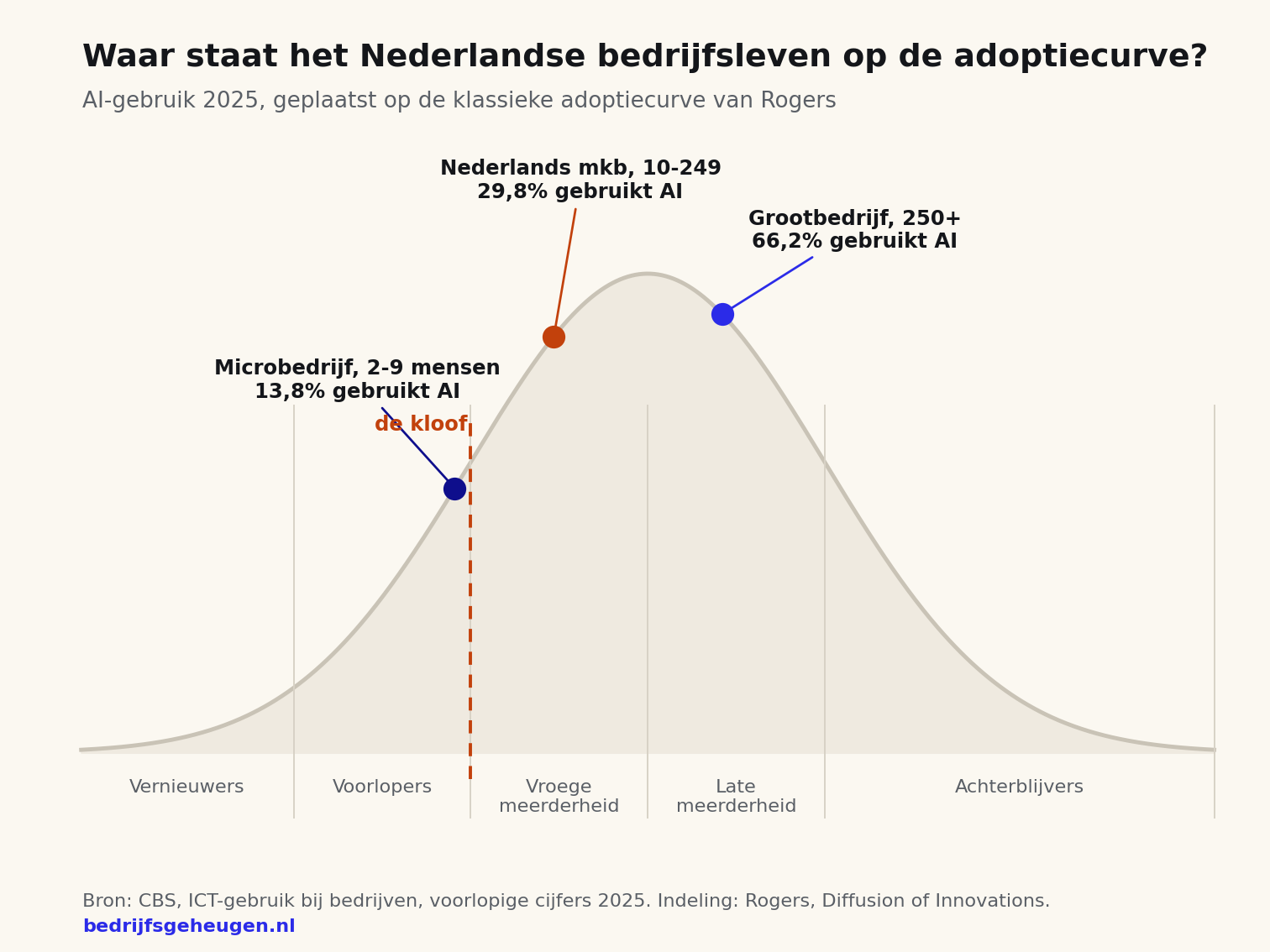
Large enterprises are in the late majority at 66,2 percent. SMEs are in the early majority at 29,8 percent. And microbusinesses are just over the chasm at 13,8 percent — the point at which a technology breaks through or remains the preserve of enthusiasts.
What this means for a company with three to fifty employees. You’re not a laggard. You’re on the threshold. That’s a very different starting point, and it determines whether you get started now or wait another year.
Where does it go?
The CBS series has now run for three years. For companies with ten or more employees, it went from 14 percent (2023) to 23 percent (2024) to 33 percent (2025). For microenterprises from 6.8 to 10.6 to 13.8 percent.
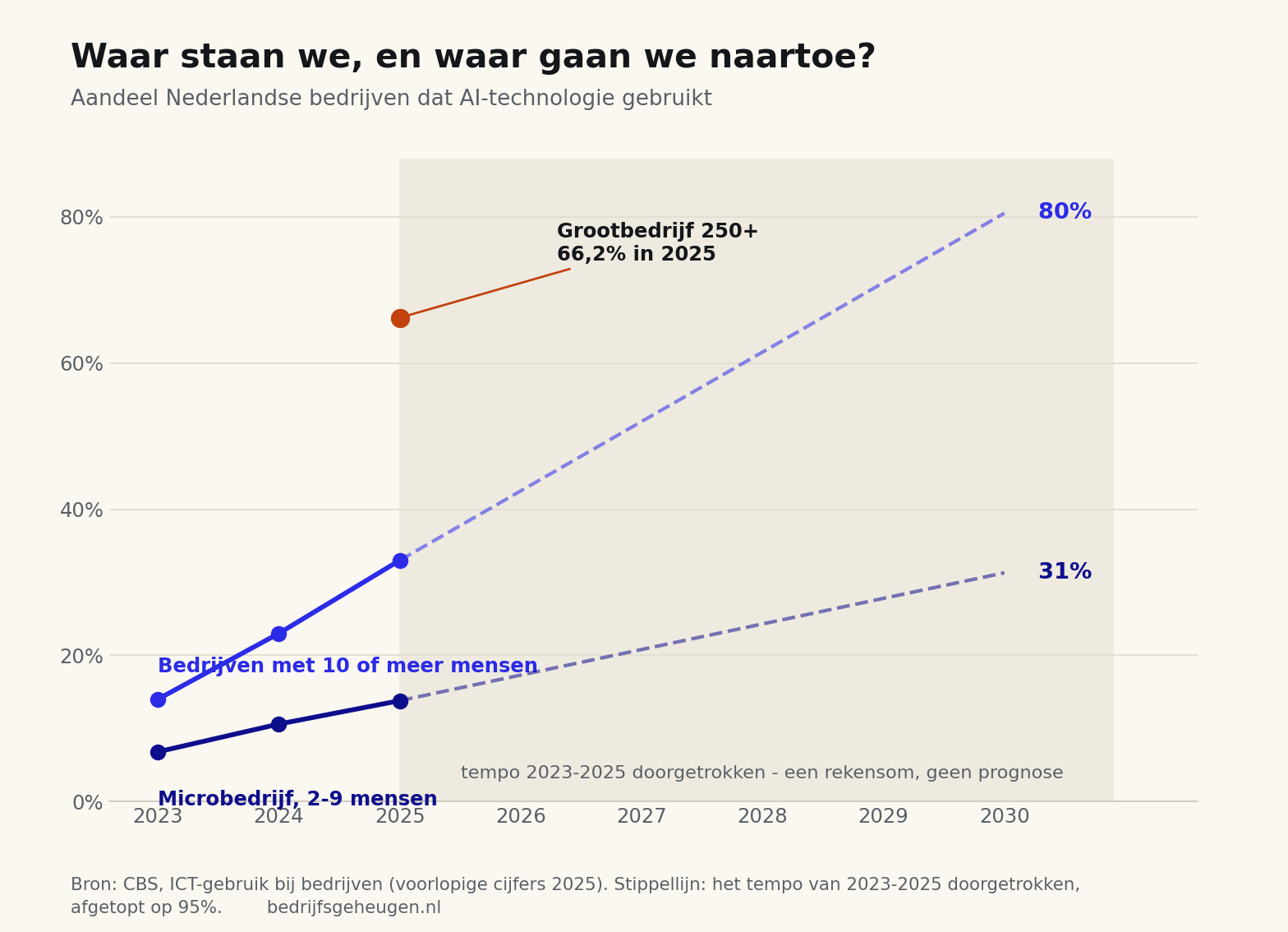
If you extend that pace to 2030, small businesses would reach around 31 percent and the rest around 80 percent. In that scenario, the gap doesn't get smaller; it gets bigger. Again: that's a straight-line extrapolation, not a prediction. Adoption curves flatten out, and things can move quickly right around the gap.
The way it works now
- The appointment is in one colleague's mailbox
- Data is manually retyped from one system to another
- The person who knows is on vacation
- No one can see afterwards why this decision was made
As it is
- The agreement is stored with the client, findable for everyone
- Once entered, information flows through to the rest
- Work continues, even if someone is absent
- Every decision has a source, an owner, and a date
Adoption isn’t the same as results
This is where it gets uncomfortable. Research from MIT NANDA (The GenAI Divide: State of AI in Business, 2025) concluded that 95 percent of the organizations surveyed saw no measurable impact on the profit and loss statement. Gartner predicted that at least 30 percent of generative AI projects would be abandoned after the proof of concept by the end of 2025, and later reported that the figure was at least 50 percent.
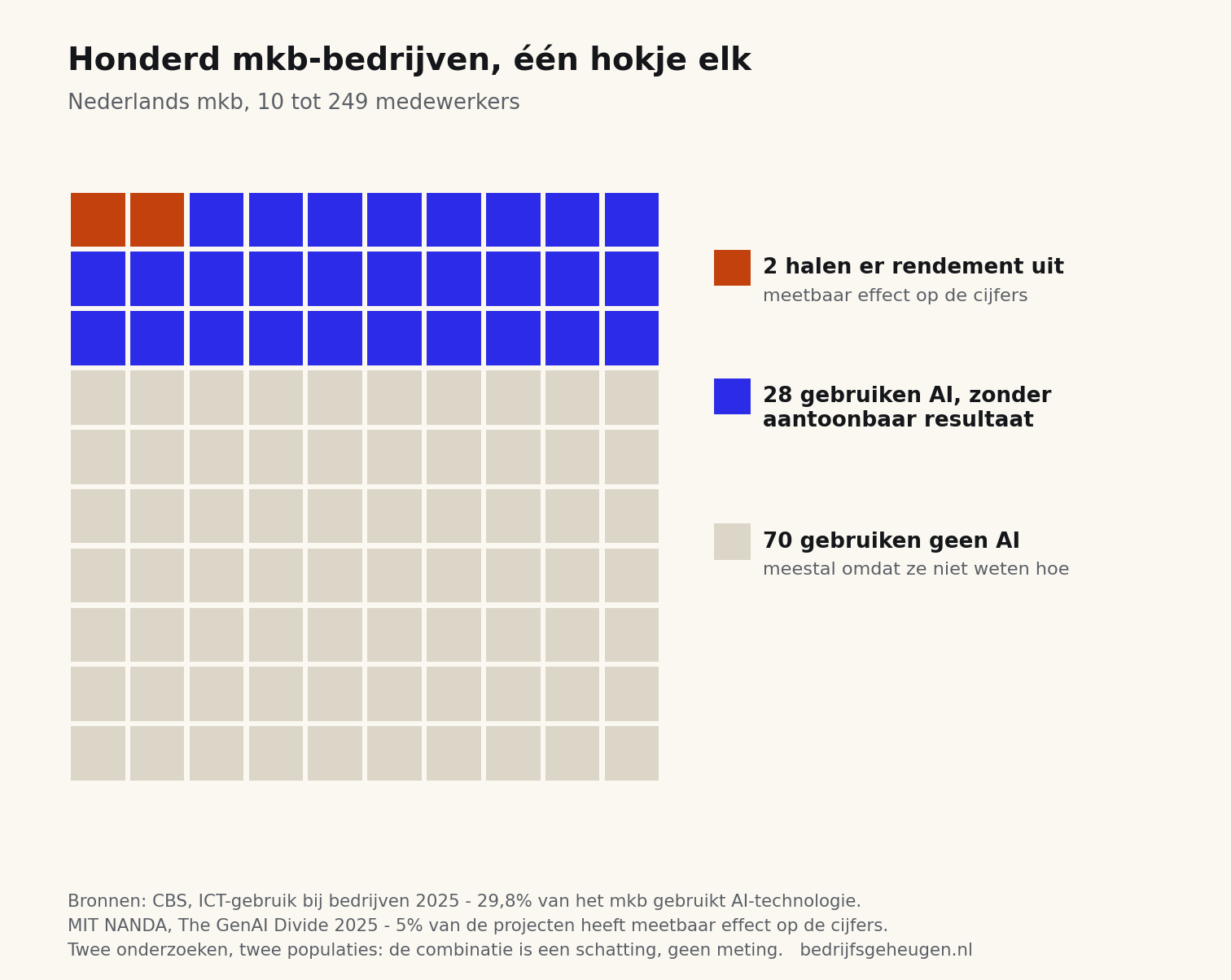
Honest about this figure. The 95 percent figure has been heavily criticized: the evidence has not been published, and the issuing party itself sells infrastructure that benefits from the conclusion. It also measures "no measurable impact on profits," not "failed" or "stopped." That's why we never use it on its own. Independent sources with stronger methodologies point in the same direction: BCG found that 26 percent of companies capture value, while McKinsey found that 6 percent achieve a real impact on profits. Broad use, rare transformation.
The cause isn’t technology
BCG surveyed a thousand executives in 59 countries and arrived at a breakdown now known as 10-20-70: approximately 10 percent of the problems lie in algorithms, 20 percent in technology and data, and 70 percent in people and processes.
CBS asked the question from the other angle. Among microbusinesses that considered AI but didn't get started, the main reason for 71.6 percent was simply lack of experience. Not the cost, not the regulations, not the technology.
Two different questions, two different populations, the same answer: implementation is the bottleneck.
What it’s worth if it works
The OECD examined Dutch business data from CBS and found that digital adoption actually supports the productivity catch-up of lagging businesses. Cloud proved to be particularly beneficial for small businesses, as they can avoid large IT investments.
The Dutch Committee for Entrepreneurship puts a figure on it: €65 billion in labor productivity potential if the majority of SMEs reach the level of the frontrunners. For comparison: labor productivity in SMEs rose by about 3 percent in ten years, compared with 11 percent in large companies.
The figures at a glance
| Figure | Value | Source | Year |
|---|---|---|---|
| AI use by microbusinesses (2–9) | 13,8% | CBS, ICT use by businesses | 2025 (provisional) |
| AI use by SMEs (10–249) | 29,8% | CBS | 2025 (provisional) |
| AI use by large companies (250+) | 66,2% | CBS | 2025 (provisional) |
| Reason not to start: lack of experience | 71,6% | CBS | 2025 |
| AI use by EU companies | 20% (was 13%) | Eurostat, Digitalisation in Europe | 2025 |
| Projects with no measurable impact on returns | 95% | MIT NANDA (disputed) | 2025 |
| Abandoned after proof of concept | ≥30%, later ≥50% | Gartner (forecast) | 2024/2025 |
| Companies getting value from AI | 26% | BCG, Where's the Value in AI? | 2024 |
| Distribution of bottlenecks | 10 / 20 / 70 | BCG | 2024 |
| SME productivity potential | €65 billion | Committee for Entrepreneurship | 2024 |
What none of these sources measure
All the statistics above count whether companies use a technology use. No source measures the cost of it not happening: how many hours a week are lost to retyping between systems, and how many places hold knowledge that resides with just one person. That figure simply doesn’t exist for Dutch companies with fewer than fifty employees.
That's why we measure it ourselves, using the Business Memory Index.
Measure what it amounts to for you
Eight questions, ten minutes. You’ll get your own figure — how many hours are slipping away and where knowledge is tied up — and, later, the report comparing results.
Accountability: every figure on this page has been checked against the original publication, not a news article about it. Where figures from different studies have been combined, that is stated explicitly, including differences in populations and definitions. Provisional figures are marked as such.
Read more: why AI projects fail and preserve knowledge when employees retire.